

How Reflection Changes Your Brain…and Your Parenting
Building the Parenting House – Part 2
In the last blog, we talked about the brick-and-mortar nature of parenting. Every experience becomes another brick. Reflection is the mortar that binds those experiences into wisdom.
But what actually happens when we slow down and reflect?
Far more than most of us realize.
Reflection doesn’t just help us remember what happened.
It helps our brains understand what happened.
Curious reflection is more than a parenting habit. It is a developmental process that changes our brains, our bodies, and ultimately our relationships.
Reflection doesn’t simply make us think harder. It changes us from the inside out.

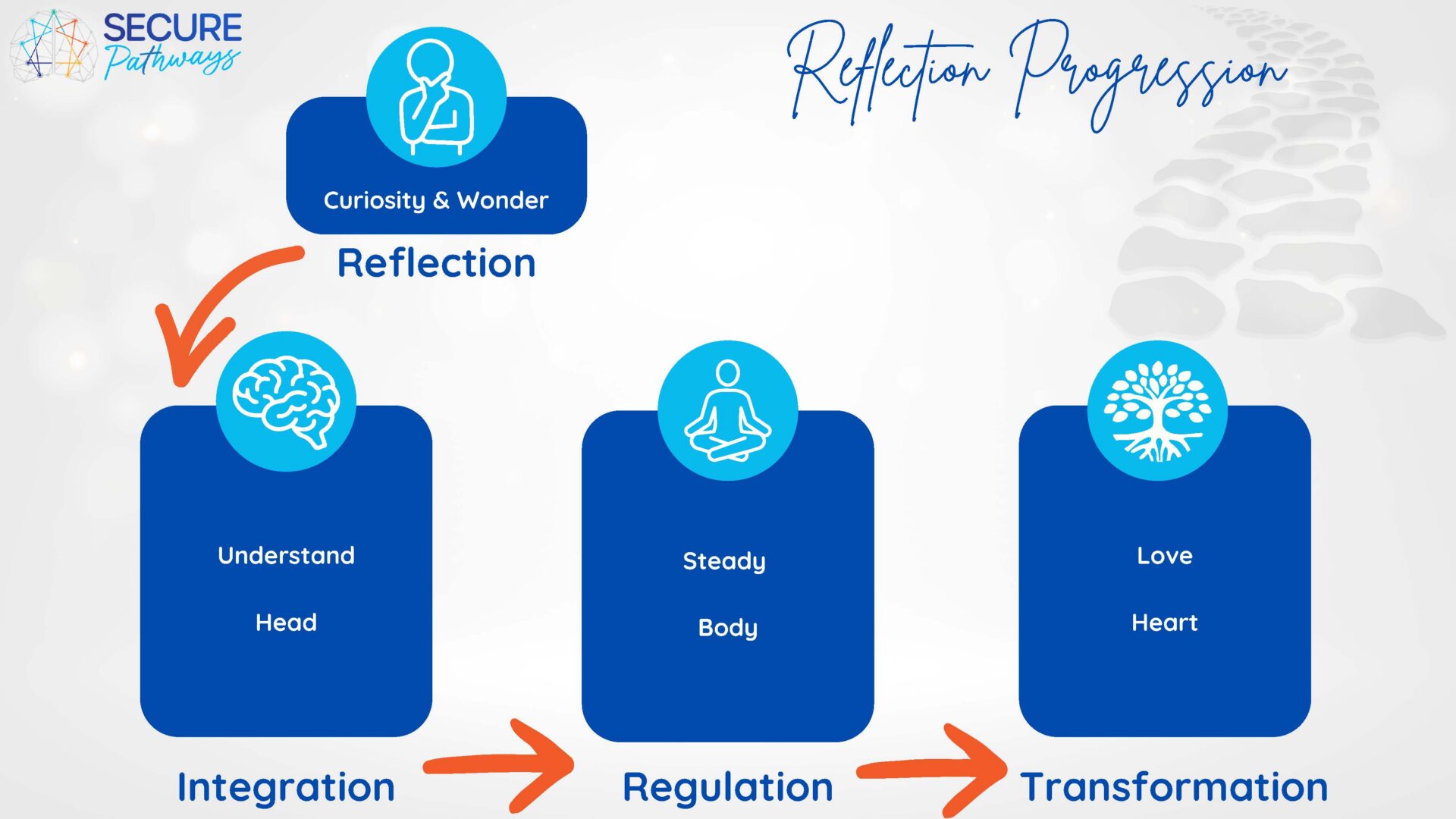
I like to think of this process as three connected stages. Each one naturally leads to the next.
Reflection creates Integration.
Integration fosters Regulation.
Regulation leads to Transformation.
This progression beautifully aligns with attachment theory, neuroscience, Christian formation, and even the Enneagram.
Let’s look at each stage more closely.
Reflection Creates Integration
Reflection is where scattered moments begin to make sense.
This stage is about understanding. The key question is: How does reflection help me make sense of my experiences?
Integration is the brain’s way of connecting scattered experiences into meaningful understanding. Through reflection individual experiences are bound into a coherent whole. It takes isolated moments and transforms them into understanding. We begin making sense of ourselves, our children, our relationships, patterns that have developed, values that are important, and God’s work in our lives.
Modern neuroscience and psychology increasingly confirm what Christians have practiced for centuries: quiet reflection changes our brains, our bodies, and ultimately our relationships.
Benefits of reflection include:
- Transforms experience into wisdom by helping us make meaning of what we’ve lived instead of simply accumulating experiences.
- Strengthens the brain by consolidating memories and reinforcing the neural pathways that support learning, insight, and wise future decisions.
- Reveals patterns in our thoughts, behaviors, parenting, and relationships that we might otherwise overlook.
- Clarifies values and priorities by helping us step back from the demands of daily life and remember what matters most.
- Develops self-awareness and a coherent sense of identity by helping us understand our thoughts, emotions, motivations, and who we are becoming.
- Increases perspective-taking by helping us understand what may be happening behind our child’s behavior, as well as our own.
- Encourages creativity and insight by allowing the brain to connect ideas that may not have seemed related during the experience itself.
Instead of simply remembering what happened…we begin understanding why it happened and what it means.
Integration Fosters Regulation
Understanding alone isn’t the end of the story. As our experiences become integrated, something remarkable begins to happen. We become steadier. Our minds, emotions, and bodies become more regulated.
Reflection helps us move from reacting to responding.
This stage is about stability. The question is: How does reflection change my nervous system and emotional responses?
When we slow down, the quiet pondering steadies our nervous system, increases emotional control, brings our thinking brain online, and creates the internal space needed to respond with wisdom instead of habit or survival instincts. Our brains and bodies become more regulated.
Benefits include:
- Calms the nervous system by activating the body’s “rest and restore” response, lowering stress hormones (i.e. cortisol), and reducing chronic stress.
- Improves emotional regulation by helping us process emotions instead of being controlled by them.
- Strengthens the thinking brain by engaging the prefrontal cortex and improving communication between emotion and reason.
- Increases resilience and patience by creating space between stimulus and response.
- Improves judgment and decision-making by helping us respond thoughtfully rather than react automatically.
Instead of parenting from fear or frustration…we begin responding with calm and wisdom.
Regulation Leads to Transformation
Most parents hope reflection will help them become better parents. And it does. Over time, though, it accomplishes something even greater. It changes the parent. God doesn’t simply use reflection to improve our parenting. He uses it to transform our hearts.
Reflection changes who we become.
This stage is about formation. The question is: How does reflection reshape my relationships, my character, and my walk with God?
As we become more integrated and regulated, our relationships, character, and spiritual lives begin to change. Our hearts are more aligned with God’s heart. We are better able to connect with others and discern the best path forward.
Reflection doesn’t simply improve parenting skills—
it gradually forms us into the kind of people God is shaping us to be.
Benefits include:
- Deepens empathy and attunement by helping us understand and pay attention to our child’s thoughts, emotions, and needs beneath the surface.
- Strengthens relationships by helping us recognize how our words, tone, and actions affect others and encouraging repair after conflict.
- Increases compassion by helping us respond to others’ struggles with grace instead of judgment.
- Cultivates humility by revealing blind spots and inviting lifelong growth.
- Develops wisdom and discernment by helping us apply what we’ve learned to future situations.
- Deepens our relationship with God by creating space for prayer, listening, and recognizing His work in our lives.
- Forms Christlike character by gradually transforming not just our parenting skills but our hearts.
Reflection doesn’t simply make us better at parenting. It changes the kind of people we become.
Reflection rarely happens by accident.
Our lives are noisy.
We move from one responsibility to the next without stopping long enough to notice what is happening inside us or our children.
That’s why practices like silence, prayer, journaling, Sabbath, and contemplative walks matter. They create the margin that allows reflection to take place.
Imagine finishing a difficult day with your child. Instead of replaying the conflict over and over—or trying to forget it—you become curious.
Why did I react that way?
What was my child experiencing?
What is God showing me?
When we become more reflective, ordinary parenting moments turn into an opportunity for growth. The experience itself does not change. You do. When your brain, body, and heart are fully engaged as you allow God to lead you, you become a more secure parent.
One of my favorite discoveries is that this progression beautifully mirrors the three Centers of Intelligence in the Enneagram.
Head → Integration
Body → Regulation
Heart → Transformation
Healthy parenting requires all three.
Final thoughts
This reflection practice begins with curiosity. Curiosity asks…
“I wonder why I reacted that way.”
“I wonder what my child was feeling.”
“I wonder what God wants me to see.”
In a noisy world, quiet reflection offers three remarkable gifts. This is shown by ancient Christian practices and by current research in psychology, neuroscience, and biology.
It integrates our experiences.
It regulates our minds and bodies.
It transforms our relationships and our hearts.
That’s why practices like silence, solitude, stillness, journaling, prayer, Scripture meditation, and Sabbath have been treasured for centuries. They don’t merely help us relax. They help us become whole.
Every day of parenting gives us another brick.
Reflection is the mortar that binds those everyday experiences into a strong and lasting foundation.
Without reflection, we simply accumulate experiences.
With reflection, those experiences become wisdom that steadies our minds, deepens our relationships, and, by God’s grace, gradually transforms our hearts.
Parent Coaching with Secure Pathways
👉 Want this type of content sent directly to your inbox? Add me to your newsletter here!